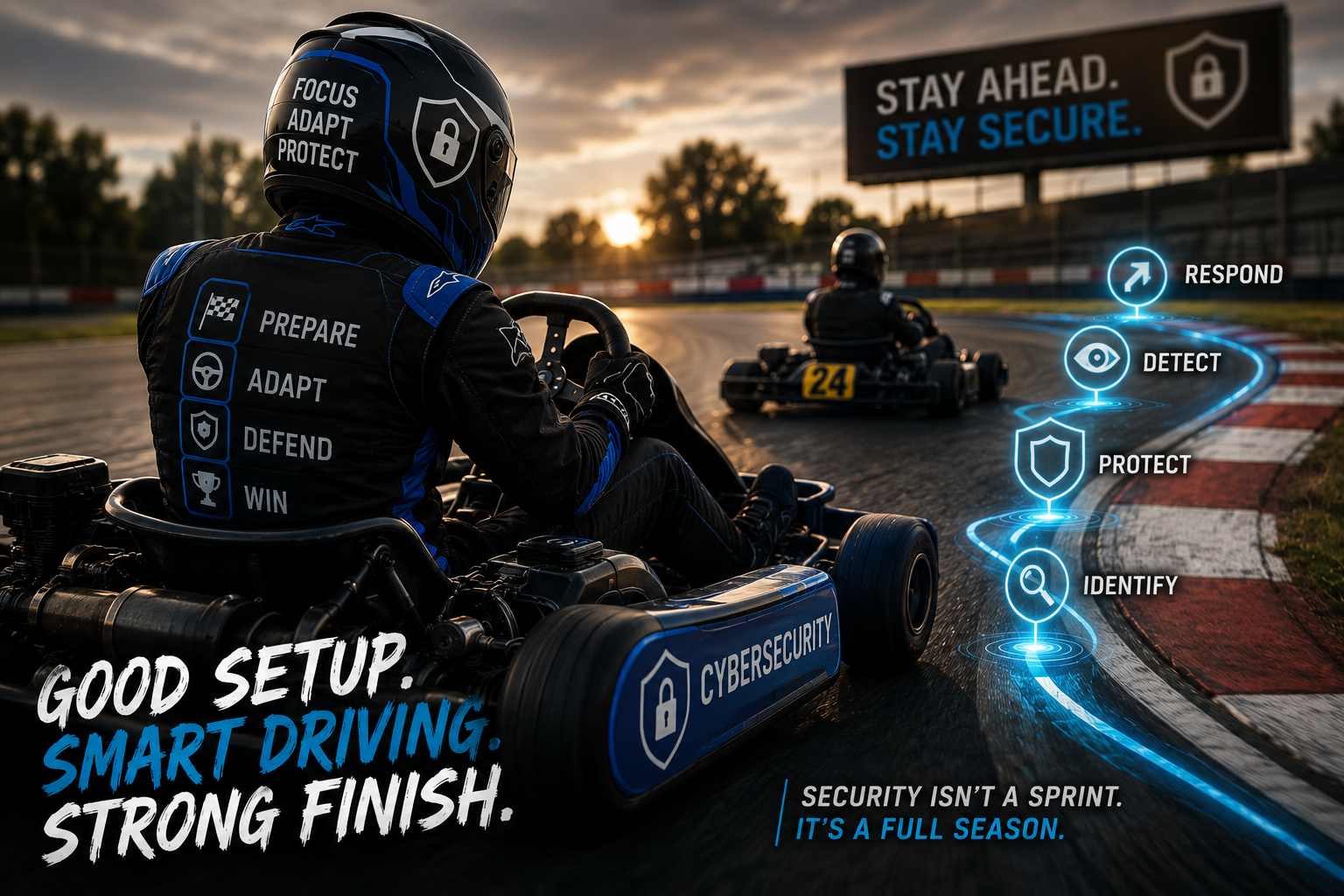
I was eight years old the first time I strapped into a kart. By the time I was fourteen, I had logged more laps than I could count — and traded it all in. Not for something flashy, but for something better. My dad, my grandfather, and a 1968 Ford Mustang California Special that needed some love. Selling the kart equipment to fund that restoration is one of the best decisions I ever made. But those six years on the track stuck with me in ways I didn’t fully appreciate until I found myself in a career built around cybersecurity.
Turns out, a lot of what I learned behind the wheel still applies. I explored a similar idea when I wrote about golf and cybersecurity a while back. But karting hits a little differently — it’s faster, rawer, and honestly a lot less forgiving.
The Track Never Stays the Same
One of the first things you learn in karting is that the track changes. Rubber builds up on the racing line as the day goes on, shifting where you can carry speed and where you can’t. Weather changes grip levels. Even the time of day affects how your kart handles. The drivers who struggled were the ones who found a setup that worked in the morning and refused to adjust by the afternoon.
Cybersecurity works the same way. The threat landscape is not static. New vulnerabilities surface, attack methods evolve, and the adversaries adapting to your defenses are not taking the day off. A security posture that worked last year may leave you exposed today. Staying rigid is a liability.
Setup Is Everything
Here’s something that takes new kart racers a while to understand: you can put the fastest driver on the planet in a poorly setup kart and they will get beat by an average driver in a well-tuned one. Chassis geometry, tire pressure, gearing ratios — every one of those variables has to be dialed in before you ever hit the track. Get the foundation wrong and no amount of talent covers for it.
I think about this constantly in cybersecurity. Organizations love to chase the latest tools. A shiny new endpoint detection platform, the hottest threat intelligence feed — and none of it matters if the underlying architecture is a mess. Poorly segmented networks, misconfigured firewalls, and overprivileged accounts are the karting equivalent of a loose front end. You are already behind before the race starts.
Look Through the Corner
One of the most repeated pieces of advice in karting: look through the corner, not at it. Your eyes should be tracking where you want to go, not fixating on the obstacle in front of you. Drivers who stare at the wall usually find it.
Reactive security is staring at the wall. By the time you are responding to an active incident, you are already in damage control. The teams that consistently come out ahead are the ones who are thinking about what is coming — threat modeling, proactive monitoring, regular assessments. They are looking through the corner.
The Kart Is Not the Driver
I raced against kids with better equipment than me more times than I can remember. Newer chassis, fresher engines, tires that had not been heat-cycled into oblivion. Sometimes they won. But not always. Because a kart does not drive itself.
The same is true in security. Vendors will always sell you the idea that their product is the answer. And some of those products are genuinely great. But tools require people who understand them, processes that support them, and an organization willing to act on what they surface. The fundamentals — patching, access controls, user awareness, incident response planning — those are the skills that win races. The equipment just helps.
Final Thoughts
I have not sat in a kart in a long time. But I think about those years more than you might expect. There is something about operating at the edge of control — reading conditions, trusting your setup, staying ahead of what is coming — that maps surprisingly well to the work I do now.
Cybersecurity is not a single race. It is a full season. And the teams that win are not always the ones with the biggest budget. They are the ones that show up prepared, adapt when conditions change, and never mistake good equipment for good judgment.
What about you? Are there unexpected places where you have found lessons that shaped how you think about security? Drop it in the comments. I would love to hear it.
Prost!
Leave a Reply
You must be logged in to post a comment.